

Welcome to 1953
A Permit for Desecration

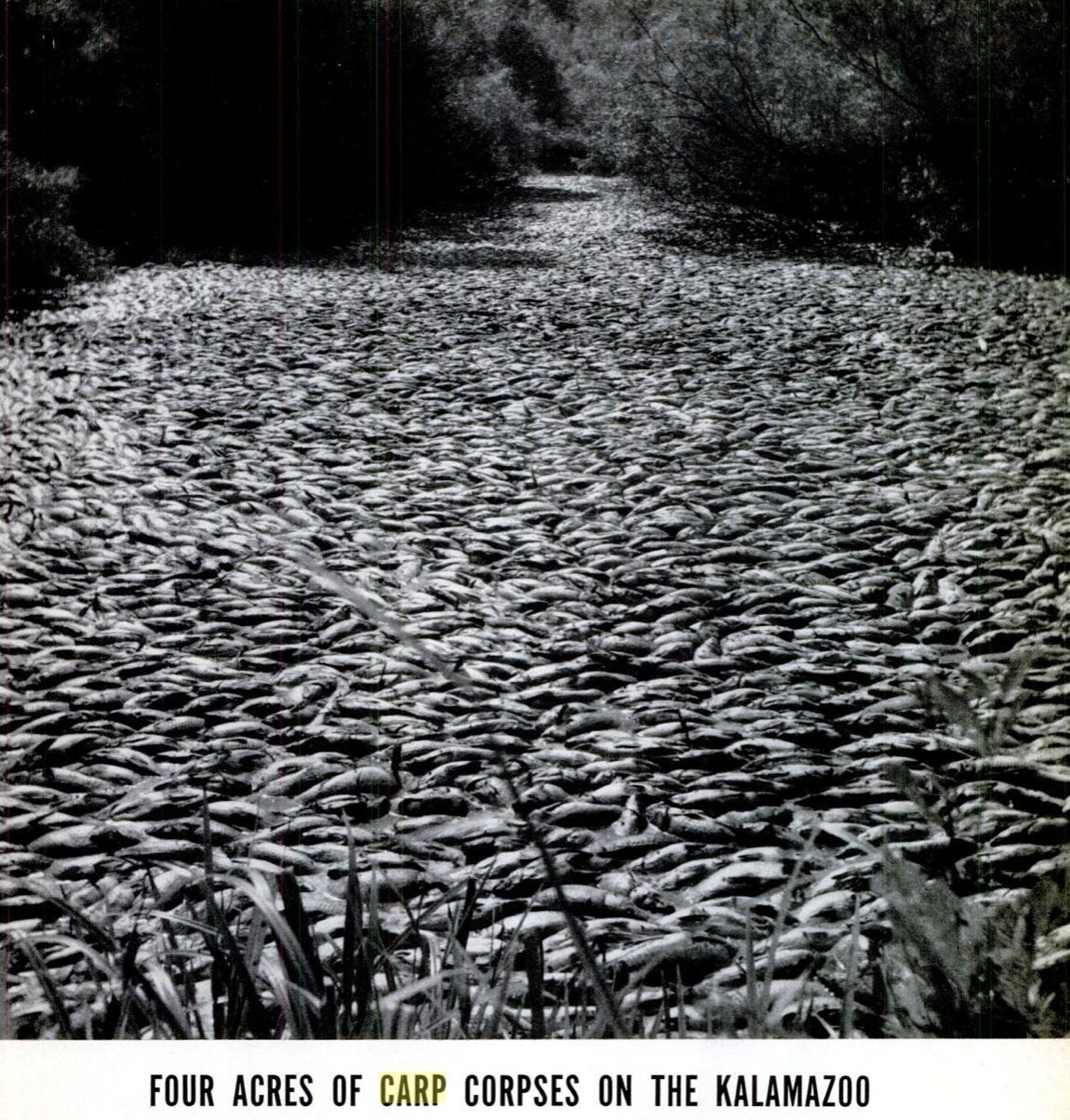
On October 5, 1953, while Enbridge’s contractors worked to construct and install the Line 5 pipeline, Life Magazine—at the time among the most widely circulated publications in the U.S.—published a gruesome photo of Dumont Creek, a small tributary of the Kalamazoo River. The photograph, captioned “Four Acres of Carp Corpses on the Kalamazoo,” depicts a massive fish kill: hundreds of dead carp heaped upon one another, their floating corpses receding into the distance and, as the caption read, “chok[ing] the waters in glistening, smelly death.” The photo was meant to capture something fundamental about the horrifying extent of water pollution in the U.S. at midcentury. Rivers and other bodies of water all across the country were routinely treated as sewers for human excrement, thoughtlessly used as dumping grounds for all manner of industrial waste.
Air quality wasn’t much better. In the second week of November 1953, for example, New York City experienced a miasma of smoke, lead, and other pollutants so thick and foul that residents found it dangerous to leave their homes. Later studies found that the air pollution that week led to the deaths of as many as 25 New Yorkers per day. Conditions weren’t much better elsewhere.
Other scourges threatened the environment and nonhuman animals as well. In 1953, a physician named Morton Biskind published a scientific article warning of the dangers of newly developed pesticides like DDT. Despite his warnings, pesticide use only accelerated, poisoning birds, fish, squirrels, and even house cats. It would be another decade before Rachel Carson’s foundational book, Silent Spring, finally convinced policymakers and the public of the reckless use of these harmful chemicals, many of them manufactured from petroleum feedstock.
But for sheer devastation, pesticides don’t come close to nuclear radiation. In 1953, the U.S. government conducted what it called Operation Upshot-Knothole at its Yucca Flat test site in Nevada. The series of eleven nuclear shots, most notoriously, the detonation termed “Dirty Harry,” released as much radiation as the infamous 1986 Chornobyl disaster in Ukraine. Thousands of residents of nearby St. George, Utah, were exposed, as were thousands of sheep and other livestock on surrounding ranches. Government attempts to downplay the exposure obscured the data, but rates of cancer and deaths of animals far exceeded norms. Infants who received fresh milk within days of the tests revealed radiation levels hundreds of times over limits considered safe, even in 1953.
Remarkably, the government’s nuclear program wasn’t even the worst example of the era’s disregard for (some) human lives. In May 1953, before the ink had even dried on President Eisenhower’s permit allowing Line 5 to cross the international border at the St. Clair River, Eisenhower issued Executive Order 10450, which banned homosexuals from all federal employment. In 1953, states could still legally ban interracial marriage. In 1953, Jim Crow reigned across the South, making sure that schools, buses, restaurants, and other public spaces remained racially segregated. Redlining was also a common practice in the North.
On August 1, 1953, just days before Line 5 would be dragged across the Straits of Mackinac, the U.S. Congress passed House Concurrent Resolution 108, which initiated the federal government’s new termination policy, renouncing federal recognition of Native American tribal sovereignty—yet another attempt to annul treaties and force the assimilation of Indigenous peoples into settler culture. In 1953, only one woman served in the United States Senate. In 1953, not a single woman held the governorship of a U.S. state. In 1953—I’m not making this up—the Eisenhower administration launched what it called, in brazenly racist language, “Operation Wetback,” a military-style campaign to remove Mexican immigrants from cities all across the United States
The list goes on. In 1953, the U.S. experienced a polio epidemic. In 1953, houses were still built with asbestos. In 1953, people smoked cigarettes on airplanes, in schools, and in hotel lobbies. In 1953, house paint was laced with toxic lead. In 1953, seatbelts were not standard in cars. And in 1953, people—but not everyone!— thought it was a good idea to lay twin oil pipelines on the bottomlands of the Straits of Mackinac, one of the most sensitive ecosystems on the planet.
Welcome back to 1953.
Yesterday, Governor Whitmer’s Department of Environment, Great Lakes, and Energy granted Enbridge a key permit for the foolhardy Line 5 tunnel; the United States Army Corps of Engineers permit will surely follow very soon. Although not surprising, it’s a stunning decision, and not only— though this is bad enough— because it gives Enbridge permission to desecrate Indigenous burial grounds. It’s also in keeping with the Trump administration’s campaign to Make America 1953 Again. After all, for virtually every item I’ve listed above, there’s a precise counterpart today: the gutting of the Environmental Protection Agency and the rollback of water and air quality regulations, the complete dismantling of the Endangered Species Act, the assault on DEI designed to undo progress on racial equality, militarized ICE thugs deployed to American cities to deport immigrants, rescinding federal protections for LGBTQ+ people, the (fortunately failed) attempt to overturn birthright citizenship that would threaten Native American citizenship rights, Trump’s recent announcement that he wants to restart nuclear weapons testing. All this is not a coincidence.
And yet, you’d have hoped a Democratic Governor wouldn’t be complicit in returning us to such a destructive past.
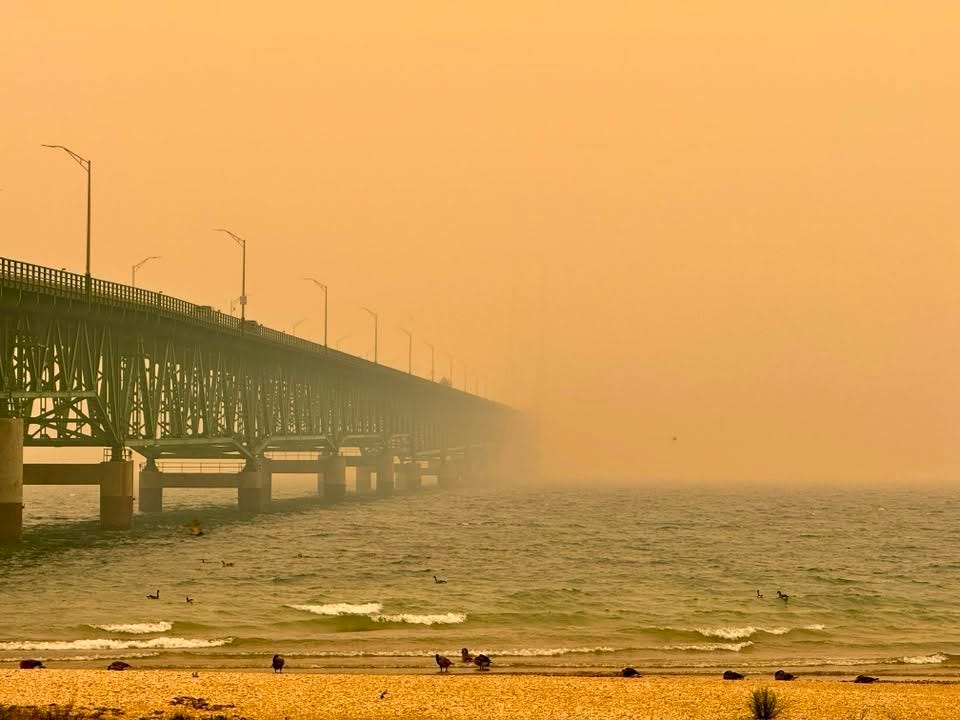
The tunnel has always been an absurdly backward-looking idea, a twentieth-century plan for a twenty-first-century world. The last thing a planet on fire needs is a billion-dollar investment in fossil fuel infrastructure. Just step outside right now and try to breathe the air from wildfires raging in Minnesota and Canada. That fact alone makes the decision bad enough. But it’s much worse than that. We should also recognize that this decision is inseparable from the broader effort, taking place on any number of fronts, by racist authoritarians to erode democracy and drag America back to a time when health, dignity, opportunity, and civil rights extended to the few, not to the many, and a time when corporate abuse of the nonhuman world went almost entirely unchecked. So let’s just be honest: more than just a risky idea, the tunnel is a fascist project.
Governor Whitmer and EGLE had a chance to decide between the past and the future, between the world as it was 73 years ago and the world as it could be, between capitalist profit and a clean, habitable planet for generations to come, between fascist authoritarianism and egalitarian democracy. They chose the world of 1953.
Express your disgust with the tunnel permit award. Take our Can’t See Straits action and email Gov. Whitmer and Director Roos.
Thank you for writing. Whew.
Line 5 is our country's most dangerous pipeline, and Enbridge has a deplorable spill record. The incomparable Lake Superior and her sister lakes hold 1/5 of the entire amount of fresh water on the planet. When this pipeline ruptures--a matter of when, not if--what do we do then? My hometown gets all of it's water from Lake Superior, as do most towns up here. A further unnecessary threat is the proposed Copperwood mine which will discharge wastewater into a river that runs directly into Lake Superior. "Pure Michigan" begins to ring hollow....where are our sensible priorities? You can't drink oil--or data. When we can no longer drink the water or breathe the air, nothing else will matter.