

Bad Attachments
What if our biggest obstacle to shutting down Line 5 isn’t the pipeline, but the story we’ve been telling ourselves about modern life?

One evening back in 2017, I found myself chatting over a cocktail with the president of a major U.S. pipeline company. The occasion was the annual conference of the Pipeline Safety Trust. I’d organized a panel earlier that day featuring three scholars— a historian, an anthropologist, and a literary critic. The panel’s topic was the Energy Humanities, a new field of study that examines the social, political, cultural, and aesthetic dimensions of energy sources and insists on the importance of humanistic methods and insights, rather than just science and engineering, for making our way toward a less destructive energy future. Although a room full of state and federal regulators, engineers, and pipeline company executives comprised an unlikely audience for such a discussion, the panel was well-received. As we sipped our drinks, the pipeline President said as much, but also had a question for me. “Without oil,” he asked, “how will we continue our modern way of life?”
I’m not quite sure whether he meant the question rhetorically, like some kind of “gotcha.” I’m familiar with that sort of thing: the smug, thoughtless equivalent of wagging a finger at the anti-pipeline activist who drove her car to the rally. But taken earnestly, it’s really not such an unreasonable question. In fact, the reason I’ve been thinking about that exchange this week is because it’s more or less the central question of the summer course I’ve just begun teaching on “Petrofiction.” The class explores works of fiction—short stories, novels, movies—that dwell in oil. Some of them, like Upton Sinclair’s 1926 novel Oil!, Italo Calvino’s 1974 short story “The Petrol Pump,” or Nnedi Okorafor’s 2011 story “Spider the Artist,” know they’re about oil. Others, like Bruce Springsteen’s classic song “Born to Run” (1975), the film The Fast and the Furious (2001), or Cormac McCarthy’s novel The Road (2006) don’t.
Either way, the point of studying petrofiction, the point of the Energy Humanities, is not just to vilify the combustion of fossil fuels, the main driver of climate change. Rather, it’s to recognize that if we’re going to learn how to live without oil—and we must— we need to understand how we’ve lived with it and the hold it continues to have on us. As the petro-critic Stephanie LeMenager puts it in her remarkable book 2014 book Living Oil, we need to understand why “twentieth-century petromodernity offers strong resistance to the imagination of alternatives, even as we recognize its unsustainability.” Or put more simply, she asks, why does “the world that oil makes remain so beloved?”
These are questions, I think, that lie at the heart of the debate over Line 5. I often find myself puzzled as to why so many otherwise sensible people support Line 5 or support the Line 5 tunnel. What makes its decommissioning so frightening and what makes the tunnel scheme seem like a reasonable solution?
One answer is that Line 5 is a proxy for the anxiety-inducing prospect of a post-oil world. Oil structures and saturates our lives. It’s not just in our gas tanks. It’s in our computers and cell phones, our clothes, our personal care products; it’s on our skin and in our teeth and in our bloodstreams. It’s also in our emotions and desires and dreams. The thrilling sensation of going fast, the comfort of a warm shower on demand, mobility as the essence of freedom and autonomy, a suburban house with a two-car garage as a measure of economic success: all brought to you by oil.
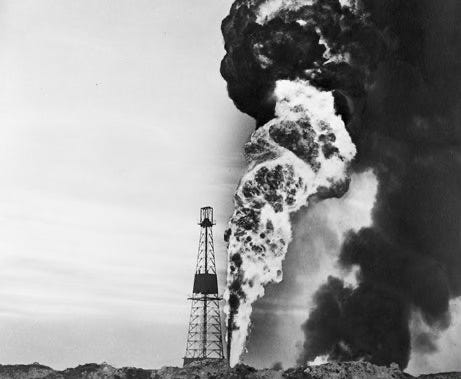
Clinging to Line 5, I think, is just another way of clinging to the world that oil has made, the only world most of us have known. We may worry, too, that a world after oil will require us to give up things to which we’re deeply attached, to give up even part of our selves. That’s not easy, especially if you’re someone lucky enough to have gotten lots of things (wealth, belongings, power) from the world oil has made or if you’re someone who yet aspires to have those things. That’s why it’s important to remember that the benefits of petromodernity have not been distributed evenly. Lots of people in lots of places around the world, for example, bear the brunt of oil extraction while receiving very few, if any, of its benefits. So the “we” conjured by a phrase like “our modern way of life” is far from universal. But even for those within that fold, oil now promises far more harm—rising sea levels, intensified storms, devastating wildfires—than good. It’s a bad attachment.
Clinging to Line 5, I think, is just another way of clinging to the world that oil has made, the only world most of us have known.
According to one Energy Humanities scholar, the modern history of fossil fuels has been an oscillation between exuberance and catastrophe: dramatic gushers promising riches on the one hand and blighted landscapes on the other; astonishing mechanical power, yet destruction on massive new scales; petrochemical innovations that have given us fertilizers and pharmaceuticals, but also algal blooms and toxic pollutants in our water and air.
There are lessons and challenges here for the Shut Down Line 5 movement. We’re pretty good at conjuring catastrophe. We tend to lead with it. It’s right there in the pipeline’s history, in the worst-case-scenario spill modeling, even in our metaphors: “a ticking time bomb.” But I wonder whether we should try to get better at exuberance, at stirring wishes and dreams, not just stoking fears. There’s no longer anything exuberant about continuing to produce more jet fuel or feed petrochemical refineries. There’s nothing exuberant about letting a pipeline company exploit the Great Lakes for private profit or helping maintain oil production for another hundred years. There’s not even much exuberant about escaping disaster just in the nick of time. The exuberance lies in the world we make after Line 5 is gone, after the age of oil.
So maybe we need to spend a little less time telling stories about looming catastrophe and more time telling exuberant stories about a world without Line 5. The question is not, what do we suffer if Line 5 keeps operating, if petromodernity persists? The question is, what do we gain from shutting the pipeline down, from releasing ourselves from oil’s sticky grip?
Nous avons commencé à entendre parler de transition des énergies autour de l'an 2000. Une société normalement lucide aurait dès lors tenu compte des avis scientifiques pour prévenir à l'évidence des catastrophes à venir.
What do we get? We are assured of having clean water to drink. Our children will have clean water to drink. Their children will have clean water to drink. Forever. Clean water is life itself. Enbridge does not have the right to hold 20% of the world’s clean water hostage to its whims of making money so the rich can get wealthier.